Thursday, February 2, 2012

Here comes February!

Happy February and Groundhog Day!

As many of you may have seen, our resident Great horned Owl, Marcus, was featured on the cover of Explore LI in Tuesday's Newsday. Many people have seen the story and come by the arboretum to meet our resident wildlife. The photos for this shoot were taken several weeks ago by LI photographer Heather Walsh . As always, our resident animals were captivating and photogenic.


Things have started to pick up a bit in the hospital and we know spring is not far around the corner! In the last few days we admitted another Mourning Dove and a Lesser Scaup. The Mourning Dove was another unfortunate victim of a car collision. He was in rough shape on arrival but is improving slowly. The Scaup came to us from a local veterinarian on the South Shore. This little duck was shot with a pellet. We have a follow up appointment with our veterinarian tomorrow but so far he is eating and swimming well. In addition to the lodged pellet, he also is missing some of the webbing from his feet. For many diving ducks, they rely on their webbed feet to help them catch live fish. Luckily for this scaup, his species consumes slower moving food like clams, crustaceans and insects in addition to aquatic plants and seeds. As long as he can overcome the injuries from the pellet shot, we think he'll have a good chance back in the wild. Here he is in the tub:


Yesterday, we visited one of our favorite elementary schools on the South Shore with our owls, hawk and falcon. We love going to this school as the teachers and students are so enthusiastic and excited to see the birds! We will be returning tomorrow for the final two of the five programs. Here is Addie, our Clinic Assistant, handling Solomon (Barred Owl) for one of our programs!

Lastly,on Sunday at 1pm, we'll be participating in our first Nature Adventure at the Arboretum! Come on down to meet our Virginia Opossums and Eastern Grey Squirrels and learn about the wonderful adaptations of our local mammals! Following our program, a nature hike with Bailey Arboretum's naturalist will take place at 2 pm. We hope to see you there!

Wednesday, January 25, 2012

January Thaw

This past Saturday, we woke up to snow blanketing the ground! On Sunday, we had a busy day with a new volunteer orientation and a visit from a local reporter writing a story on our new home. We filled many open volunteer shifts through this orientation and we will be working to get our new volunteers well trained prior to spring's baby season!

Now, the weather appears to have done a total 180! The snow has all melted and we are enjoying 50 degree temperatures and sunny skies! With the nice weather this week so far, our permanent resident animals have had lots of enrichment time outside of their enclosures. Below is Wyatt, our resident Eastern Grey Squirrel, on a morning romp in the yard:

Also enjoying some time outside her enclosure was Millie, our Virginia Opossum. Millie is pictured here sitting atop our brand new fence.


Here's another picture of the fence. It fits in so well with the feel of our new home!


On the rehabilitation side of things, we continue to provide care to three Eastern Grey Squirrels, a Herring Gull and a Mourning Dove at our hospital. The squirrels are progressing along nicely and two moved to outdoor cages in preparation for their release soon. The third squirrel won't be too far behind them!

Wednesday, January 18, 2012

New Year, New Home!


Happy 2012!

We're back on our blog after a long hiatus for our construction and move to Bailey Arboretum!

We open up this brand new year in a brand new home with beautiful surroundings. Thus far, January has been fairly quiet with animal patients, likely due to the warm temperatures we've been experiencing. We have taken full advantage of this "off-season" by completing some very important projects before the fast approaching spring baby season! These projects include shelf installation, building indoor aviaries, an outdoor turtle garden and enclosures for ducklings and juvenile squirrels.

Now that the holidays are behind us, many schools and organizations are scheduling education visits with our engaging resident wildlife. Last week, we headed out to the Daly School in Port Washington to teach some very enthusiastic students about our resident owls. During the program, the students had the great treat of hearing our male Great Horned Owl (a Port Washington native himself) hooting in both of our hour long programs!

Today, we conducted two "Living with Wildlife on Long Island" programs at PS-33 in Queens Village. About 190 third graders learned about the fascinating tree climbing abilities of squirrels and unique pouches of North America's only marsupial, the Virginia Opossum, from our Education Volunteer Alice.

To add to the excitement of our week, installation just started on our new split rail fence surrounding the aviaries of our resident birds of prey. This fence is the first step in building an interpretive nature trail through our permanent raptor aviaries. The fence should be fully installed by the weekend. Come spring time, the area will have plantings and interesting signs to adorn the trail as well!


We look forward to keeping you posted on the latest happenings in our hospital!
Best wishes for a happy and healthy new year!

Tuesday, June 28, 2011

New Aviaries are on their way!!


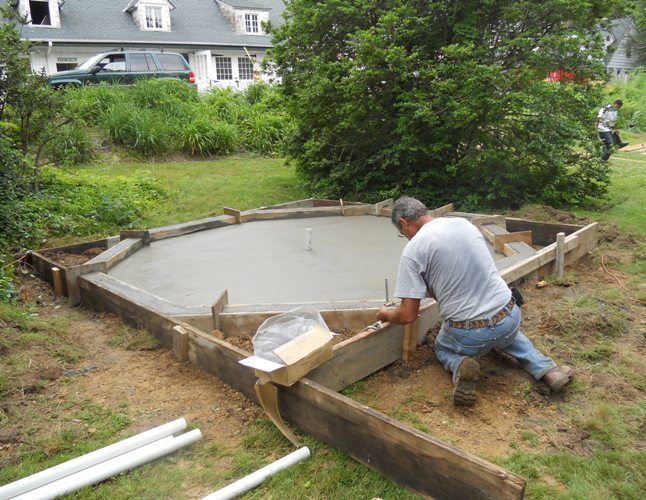
As you saw in our previous post, templates were laid for aviary foundations to be poured. I am happy to report that work has finally begun!


One of the fifteen foot foundations being detailed.


These will be our two 20 foot aviaries.


A wider view of several aviaries in progress.


The foundations are just about done and the next step is constructing the framework of our brand new aviaries. Keep us bookmarked for more updates and photos of our exciting move!


Friday, May 20, 2011

New Photos on our Move

The big question on everybody's minds these days is "Are you over at the new place yet?"

While we wish that answer was yes, we aren't over there yet. Building discoveries, permit applications, etc., always take much longer than one can anticipate, but we're happy to report that things are moving along there. I was over there on Wednesday and took some photos of the progress that has been made on the building.
Here we go!:

Above is our new door to the Admissions area :)


This will be the Admissions area, with the back room being our Exam Room


This will be our Recovery area; several aviaries will be built in this room,
allowing young birds to practice flying before heading to outdoor aviaries. It also serves as aviaries for adult birds as they progress through their recuperation.

This is where we will have some office space set up, and a small area for storage.


This is the outside aviary where our permanent education raptor enclosures will be.

Keep checking back for new pictures and developments as we continue building our new home!


Sunday, April 10, 2011

Ring-billed Gull Release!


On February 18th, we received a Ring-billed Gull from Eileen, a fellow wildlife rehabilitator. This gull had been found at a Brooklyn train station and was unable to fly. Eileen gave the gull a physical exam upon admission and noticed that the left wing was hanging lower than the right, which indicated a fracture of the humerus. The humerus is the bone that connects the shoulder and the elbow. Humeral fractures are quite common but they can be tricky- the ability for us to treat a fracture depends on where the fracture happened. Because it can be difficult to tell where a fracture is on the bone, wildlife rehabilitators tend to work closely with referring veterinarians that have X-ray equipment. With an X-ray, one can tell with more accuracy where the fracture is and thus how best to undergo treatment. Thankfully, Eileen was able to obtain an X-ray from her referring veterinarian. What they saw in the X-ray was good news! The fracture was on the middle of the bone, so there was a good chance that the gull’s wing would heal enough so that it would be able to fly again.
       After the gull was transferred to us, we began immediate treatment. We wrapped the wing so that it would hang in its natural position, and used another wrap to secure it to the body so that the wing was immobilized. This type of wrap is useful for preventing unnecessary movements of the wing (which could cause further injury), very much like an arm cast does in humans. After the wrap was on for about four days, we took it off and gave the wing physical therapy by slowly extending it and allowing it to snap back into its original position. We then gave the gull a bath so he could further exercise his wing, and then re-wrapped it for a few more days. After two weeks of doing that, we saw that the wing sat in a more natural position so we opted to keep the wrap off. This gull was well on his way to recovery!
As the weather became nicer, we put him in a large aviary outside to get some exercise. By this time, we were well into the month of March. The gull had shown a little bit of flight, but not too much. Finally, on March 29th, a volunteer mentioned that she had watched the gull fly and hover several feet in the air. The next day, as I was weighing the gull, he flew out of my hands and around our nursery, just reaching the ceiling! He was almost ready to go. Over the next two days, we noticed him flying wonderfully around his outdoor aviary. On April 2nd, a lovely spring day, he was released with full flight after a long recovery at Sunken Meadow beach.

Photo credit: http://chrissiatkisson.blogspot.com/2009_08_01_archive.html

Friday, January 14, 2011

Running into an Owl!


On December 19th, 2010, we received a call regarding an injured Eastern Screech Owl. The adult female grey phase Eastern Screech Owl was found in the road by Patrick of Northport while he was on his Sunday morning run! After finding the owl, Patrick ran home to get a box. He returned with box in hand and carefully placed the screech owl into the box and began to search for help. Luckily, he was put in touch with us and the owl was brought to our hospital soon after.

When the owl arrived, she was very cool and in shock. She was warmed up and examined. Her hefty weight of .180 kilograms indicated she was likely a female and a well-fed one at that! Unfortunately, she was pretty banged up from her ordeal (presumably an automobile collision.)
The owl was unable to stand upright. Examination of her eyes revealed vision loss in her right eye. Blood could be seen in the eye and her right eye showed no response to movement or light. Fortunately, her left eye appeared unharmed. In addition to her eye damage, the owl had a severe injury to her shoulder. The position of her wing at a harsh upward angle along with severe swelling in the shoulder region indicated a probable fracture of the coracoid. The coracoid is a bone in the chest cavity that helps to stablize the wing to the sternum to allow flight. Fractures of the coracoid will usually ground the bird temporarily, if not forever. Coracoid fractures are made even trickier to treat due to the bone's proximity to bird's internal organs.


We rehydrated the owl and started her on medication for the swelling. We stabilized her wing with a wrap that secured the wing in its natural position to the body. She was then set up to calm down from her stressful day. For several days following her initial trauma, the owl remained in critical condition. She had to be fed via feeding tube and after a few days she graduated to small rodent pieces. By the fourth day, she was able to perch on the soft towel in her cage. We continued to work with the wing over the course of the next ten days. The swelling subsided and she began to hold her wing in the correct position! Gradually, her damaged eye became more responsive as well. In early January, we were able to move her to a larger aviary to practice flight and to test her vision and hunting abilities. Luckily, the owl did better than we could have imagined!

On January 13th, almost a month after her ordeal, the owl was ready for release! She was released at the Makamah Preserve in Northport in the early afternoon to give her time to get her bearings before nightfall. The two volunteers who released her reported that she flew beautifully up to a tree branch.